Gutters, Downspouts, and Leaf Protection in Naples, Florida
Gutters are the least glamorous part of a roof system and one of the most consequential. In Southwest Florida, where a single afternoon storm can drop several inches of rain in an hour, a gutter that is clogged, pitched wrong, or pulling away from the fascia sends that water exactly where you do not want it. C&C Home Solutions installs, repairs, seals, cleans, and protects gutters across Naples and the surrounding communities, and Corey Christiansen does the work himself. Call (239) 537-1649.
How Gutters Fail in Southwest Florida
The failure modes here are specific to the climate and to the volume of water involved.
Debris is constant. Between palm fronds, oak and ficus litter, seed pods, and the sheer amount of vegetation in Collier and Lee County, gutters fill faster here than in most parts of the country. A gutter packed with wet organic debris is also heavy, which is the second problem. Weight pulls hangers loose from the fascia, and once the gutter sags the pitch is gone and standing water sits in the run permanently.
Standing water in a gutter causes its own chain of problems. It breeds mosquitoes, it accelerates corrosion at seams and fastener points, it adds more weight, and in a hard rain it overflows immediately because there is no capacity left.
Then there are seam and end cap failures. Sealant at joints, corners, and end caps dries and cracks under Florida sun exactly the way roof flashing sealant does. Those are slow drips rather than dramatic failures, which is why they are usually noticed only after the fascia behind them has already started to rot.
Finally, coastal exposure. Salt air corrodes fasteners, hangers, and any exposed metal edge faster near the water than it does inland.
Gutter and Downspout Installation
When a gutter run is beyond repair or a house needs gutters where there were none, installation is straightforward work that is easy to do badly.
The variables that matter are sizing, pitch, hanger spacing, and downspout count and placement. Sizing has to reflect the roof area draining into the run and the rainfall intensity this region actually gets, not a national default. Pitch has to be enough to move water to the outlets without being visually obvious. Hanger spacing has to account for the weight of water plus debris, and in this climate closer spacing than the minimum is the right call.
Downspout count is where undersized systems usually reveal themselves. A long run with a single downspout will overflow in a hard Southwest Florida rain no matter how clean it is, because the outlet cannot pass water as fast as the roof delivers it.
Gutter Repair and Resealing
Most gutter problems do not require replacement.
Resealing seams, corners, and end caps with proper sealant addresses the majority of drip complaints. Rehanging sagging sections and adding hangers restores pitch and stops standing water. Reattaching or replacing sections pulling away from the fascia stops water running down the wall. Downspout reattachment, replacement of crushed sections, and clearing blocked outlets restore flow.
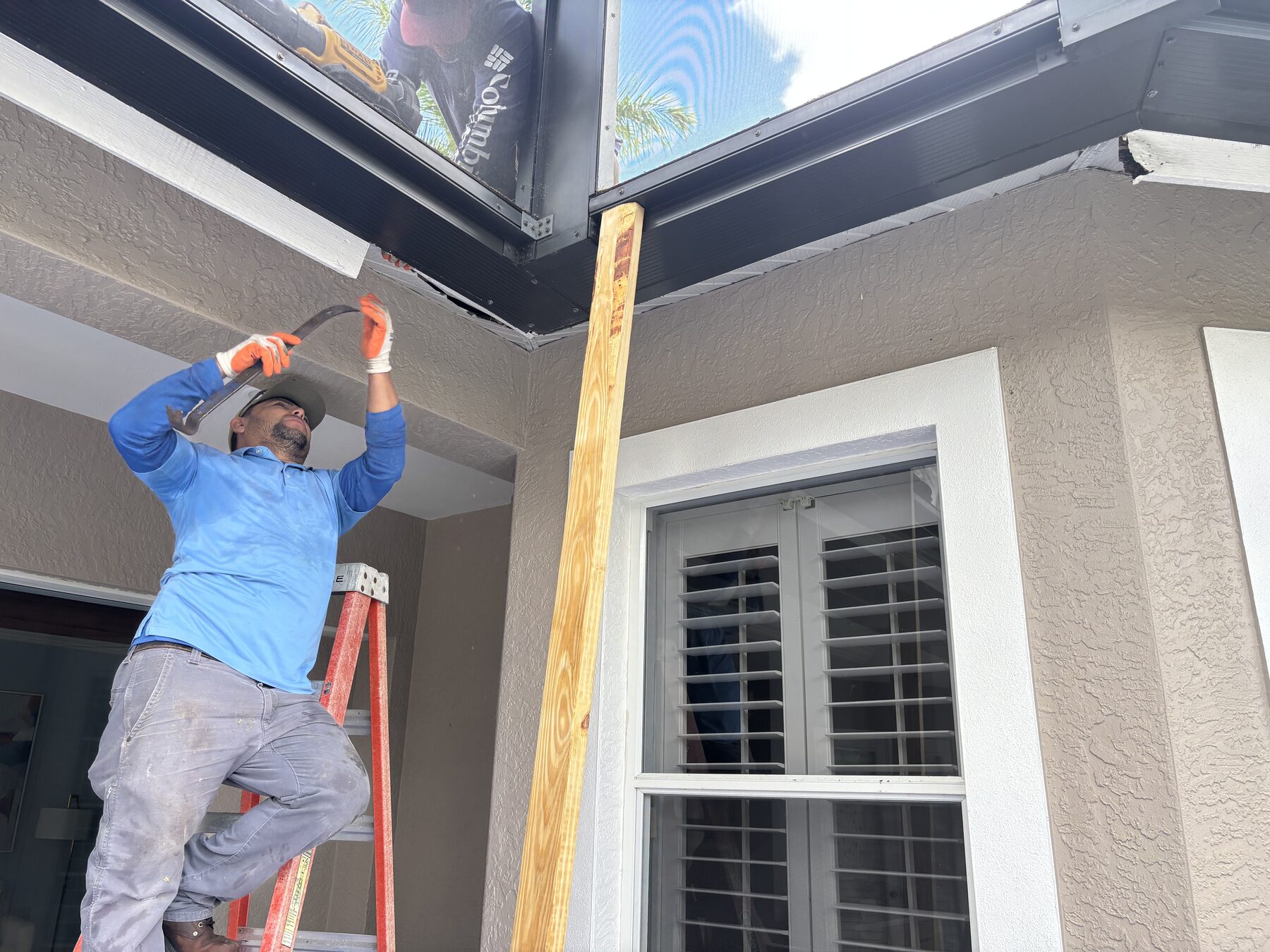
Where the fascia behind the gutter has already deteriorated from a long running leak, that has to be addressed before the gutter is rehung. Fastening a gutter back into soft wood just delays the same failure. If we find that, Corey will tell you before rehanging rather than after.
Gutter Cleaning and How Often It Is Needed Here
The standard advice of cleaning gutters twice a year is written for climates with a defined leaf drop and a dormant season. Southwest Florida has neither.
Vegetation sheds year round here, and the wet season delivers the heaviest rain of the year at the same time gutters are most likely to be loaded with debris. For most properties in this region, a realistic schedule is a thorough clearing before the wet season begins in late spring, and a second one during or after it. Properties under heavy tree cover, particularly with palms or oaks directly overhead, often need more than that.
Cleaning means clearing the runs and flushing the downspouts to confirm flow, not just scooping the visible debris out of the top of the gutter. A gutter that looks clear but has a blocked outlet is still a gutter that will overflow.
Gutter Guards and Leaf Protection
Guards reduce how often gutters need clearing. They do not eliminate it, and any company telling you otherwise is overselling.
What good guards do well is keep leaves, fronds, and larger debris out of the run so water keeps moving and the system does not load up with weight. What they do not do is keep out fine material like shingle granules, pollen, and grit, which still accumulates and eventually needs clearing.
The right guard depends on the debris you actually have. Fine mesh handles small debris better but clogs on its surface under heavy palm litter. Reverse curve designs shed larger debris well. Screens are the least expensive and the least durable. Corey will look at what is actually falling on your roof and recommend accordingly rather than fitting one product to every house.
Overflow Guards and Valley Diverters
Overflow guards address a specific and common problem: the point where a roof valley dumps a concentrated stream of water into a gutter.
A valley collects water from two roof planes and delivers it at high velocity to one narrow section of gutter. In a hard rain, that stream frequently shoots straight over the gutter entirely, which means the gutter is doing nothing at exactly the moment it matters most. Homeowners often assume this is a clog when the gutter is perfectly clear.
Overflow guards and valley diverters slow and redirect that flow so the gutter can actually capture it. Installing them is a small job that solves a problem people frequently misdiagnose as needing a whole new gutter system.
Where the Water Actually Goes
The last piece is downspout discharge, and it is the piece most often ignored.
A downspout that ends at the foundation is moving water from your roof to your foundation, which is not an improvement. Extensions, splash blocks, or underground drainage carry it far enough away to matter. In this region, with high water tables and a lot of homes on slab, persistent saturation at the foundation line is worth avoiding.
Discharge placement also matters for landscaping, for walkway safety, and for keeping water off lanai and pool deck surfaces where it creates slip hazards and staining.
Frequently Asked Questions
How often should gutters be cleaned in Naples?
At least twice a year for most properties, with one clearing before the wet season begins. Homes under palms, oaks, or heavy tree cover often need clearing three or more times a year.
Are gutter guards worth it in Southwest Florida?
For most properties yes, because they keep fronds and larger debris out and prevent the weight buildup that pulls gutters loose. They reduce cleaning frequency rather than eliminating it, since fine debris still gets through.
My gutters overflow even though they are clean. Why?
Usually one of three things: not enough downspouts for the roof area draining into the run, lost pitch from sagging, or a valley dumping a concentrated stream over the gutter. All three are correctable without replacing the system.
Can you repair my gutters or do they need to be replaced?
Most gutter problems are repairable. Resealing seams, rehanging sagging runs, and clearing blocked outlets solve the majority of complaints. Replacement is only warranted when the material itself has corroded through or been physically destroyed.
Do you clean gutters as a standalone service?
Yes. Gutter cleaning can be scheduled on its own, and it is also included when we are already on the roof for other maintenance work.
Can clogged gutters cause a roof leak?
Yes. A gutter packed with debris backs water up under the roof edge, where it can reach the underlayment, the fascia, and the decking. It is one of the more preventable causes of roof damage we see.