Tile vs Metal vs Flat Roofs: Repair Realities in Southwest Florida
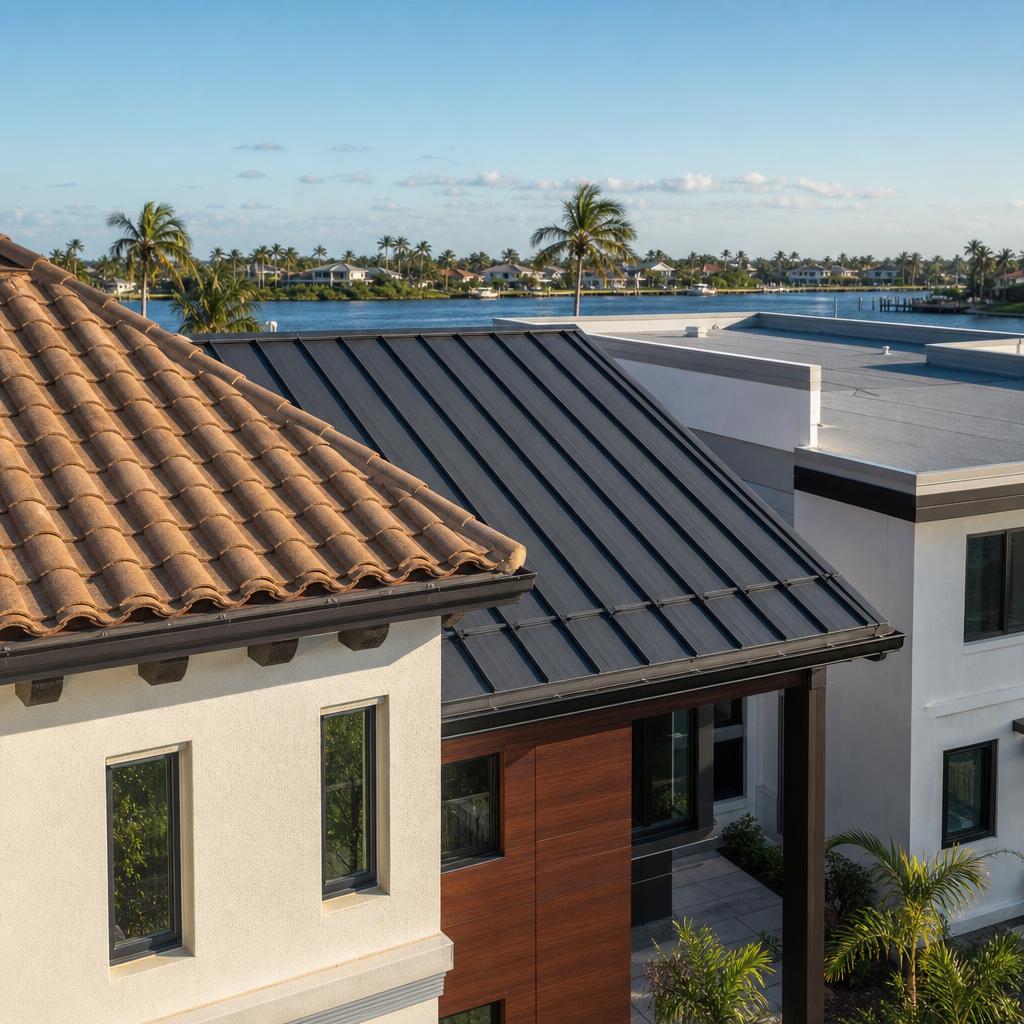
Most comparisons of roofing materials are written to help you buy a new roof. This one is written for the far more common situation, which is that you already have one and something has gone wrong with it. Each of the three systems that dominate Southwest Florida fails in its own characteristic way, and knowing which pattern you are dealing with tells you a great deal about whether you are facing a small repair or a real problem.
Tile: The Underlayment Is the Roof
Concrete and clay barrel tile is the signature roof of Collier County and much of coastal Lee County, and there is one fact about it that most homeowners do not know.
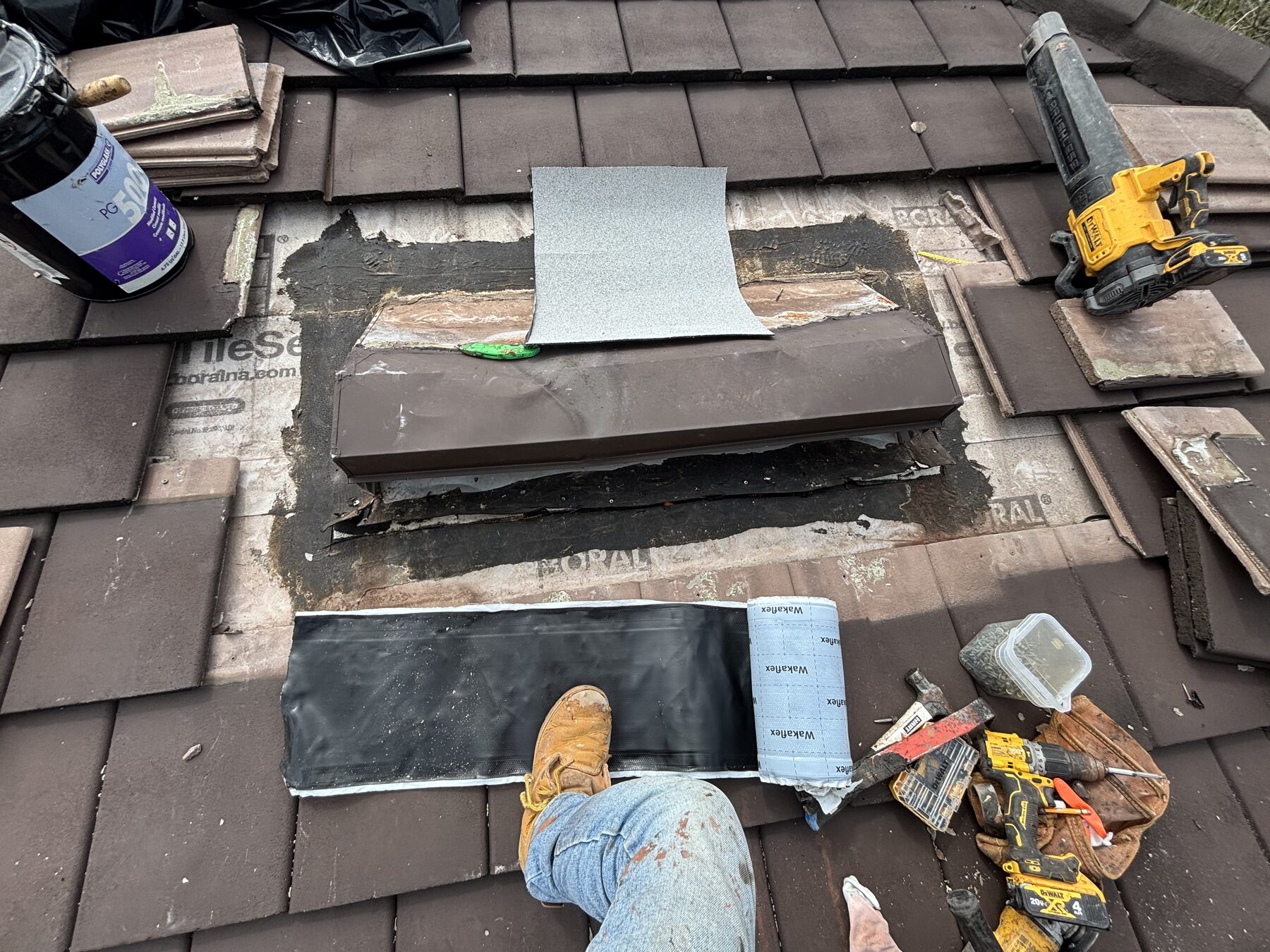
The tile is not what keeps water out. It is the outer layer that sheds most of the water and takes the sun, wind, and impact. The actual waterproof barrier is the underlayment beneath it. Water that gets past a tile is supposed to land on that underlayment and drain away harmlessly.
Tile lasts decades. Underlayment does not, particularly in this climate. That produces the situation we encounter constantly: a roof where every tile looks flawless from the street while the real barrier is at or past the end of its service life.
How tile fails: slipped tile exposing underlayment to direct sun and rain, cracked and broken tile from impact or from careless foot traffic, failed mortar at ridges and hips, and localized underlayment deterioration.
What that means for repair: most tile problems are repairable, including many that get quoted as full replacements. Repositioning slipped tile and addressing localized underlayment is standard work. Tile repair costs more than shingle repair because it is slower and more delicate, and because a careless repair breaks more tile than it fixes.
Metal: It Fails at the Fasteners, Not the Panel
Metal performs well here and it is common on newer construction, on additions, on the islands, and on manufactured housing throughout Lee County.
Its strength is wind resistance, which matters more in this region than almost anything else. Its weakness is that it is a system held together by fasteners and seams, and those are what go.
How metal fails: screws back out through years of thermal expansion and contraction, the neoprene washers beneath the fastener heads dry out and stop sealing, side seams and end laps open, transition flashing where metal meets another material lifts, and near the coast salt corrodes fastener heads and cut edges.
What that means for repair: metal roof leaks are almost always repairable without replacing panels. When someone tells you a leaking metal roof needs replacing, ask specifically whether the panels themselves have failed or whether it is fasteners and seams. It is nearly always the latter.
Flat and Low Slope: Water Sits, and Water Travels
Nearly every Southwest Florida home has some low slope area even when the main roof is tile: lanai covers, entryways, additions, carports. Condominium and small commercial buildings are often flat throughout.
How flat roofs fail: ponding from inadequate slope, settling, or blocked drainage, which breaks down membrane over time. Seams opening, on TPO where heat welds fail and on EPDM where adhered seams let go. Punctures. Failures at penetrations for vents, lighting, and mechanical equipment. Shrinkage pulling at terminations.
The complication: water that gets past a low slope membrane travels sideways inside saturated insulation before it appears indoors. The interior stain is frequently nowhere near the entry point, which makes visual diagnosis unreliable and thermal imaging genuinely valuable.
What that means for repair: most membrane failures are repairable with compatible materials. The one thing to avoid is a repair using the wrong material, which is common. Patching TPO with EPDM products, or smearing roofing cement over a membrane defect, produces a repair that fails quickly.
Which One Is Easiest to Live With Here
An honest ranking depends on what you value.
Tile has the longest life and the best appearance, and it is the most expensive to repair. It also has the most misunderstood failure mode, which is why tile owners are the most likely to be sold an unnecessary replacement.
Metal handles wind best, which is why it is common on the islands, and its failures are the cheapest and most straightforward to fix. Near the coast it demands attention to corrosion at fasteners.
Flat roofs are the least forgiving. They are the ones that need proactive attention rather than reactive repair, because by the time the leak shows up inside, the damage inside the assembly is usually well established.
The Common Thread
Across all three, the failures that actually put water in your house are small components: fasteners, boots, flashing, seams, mortar, individual tiles.
That is the case for repair specialists over replacement companies. Very few Southwest Florida roofs need to be replaced when they first start leaking. Most need a specific small thing corrected properly, and the cost difference between those two answers is enormous.